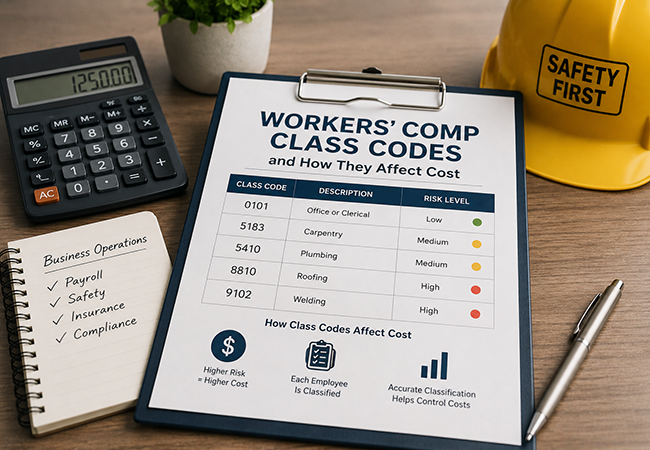
A workers’ comp class code is a four-digit number, assigned by the National Council on Compensation Insurance (NCCI), that categorizes a type of work by its injury risk. Each code carries a rate per $100 of payroll, and that rate is the single biggest driver of your premium after payroll itself. In Florida, NCCI files the rates and the Office of Insurance Regulation approves them. Get your codes wrong and you’ll either overpay for years or face a surprise bill at audit.
Two businesses with identical payroll can pay wildly different workers’ comp premiums, sometimes by a factor of 50 or more. The reason almost always comes down to class codes. Understanding how they work is the first step to making sure you’re not paying for risk you don’t actually carry.
What is a workers’ comp class code?
Class codes exist because insurers price risk, and a roofer climbing on a steep slope is a very different risk than a bookkeeper at a desk. NCCI maintains the classification system and assigns each type of work a four-digit code with an associated rate. The rate reflects the historical injury frequency and severity for that kind of work. A clerical code in Florida might sit around $0.10–$0.17 per $100 of payroll, while roofing is one of the highest-rated codes in the entire manual.
The codes are standardized, but the rates are state-specific. In Florida, NCCI files proposed rates and the Office of Insurance Regulation reviews and approves them; for 2026, the state approved an average statewide rate decrease of about 6.9%, though that’s market context, not a guarantee your specific premium drops by that amount.
How are class codes assigned?
The key principle catches many owners off guard: class codes are based on the work an employee actually does, not their job title. A “project manager” who spends time on a job site can be classified into a higher-risk construction code rather than a clerical one.
A few rules shape how this plays out:
- Governing class code. Most businesses have one primary code, the non-clerical classification that generates the largest share of payroll, which describes the core operation.
- Standard exception codes. Certain roles, like 100% office-based clerical staff and outside salespeople, can be split out into their own low-rate codes if their duties truly stay separate.
- Mixed duties default to the highest rate. If a worker performs multiple jobs and you can’t cleanly separate the payroll with proper records, insurers will often apply the highest-rated classification to all of that worker’s pay. That’s an expensive default to fall into.
How class codes drive your premium
The core formula is straightforward: (class rate ÷ 100) × annual payroll × experience modifier = premium, before account-specific credits, minimums, and audit adjustments. We walk through the full calculation in our guide to cómo se calcula el costo del seguro de compensación para trabajadores por empleado.
The spread between codes is enormous. Consider two Florida businesses, each with $200,000 of payroll:
| Empresas | Illustrative rate / $100 | Rough base premium |
|---|---|---|
| Accounting office (clerical) | ~$0.15 | ~$300 |
| Roofing crew (code 5551) | ~$15 | ~$30,000 |
Same payroll, a hundredfold difference in premium, entirely because of the class code. (These figures are illustrative; actual rates depend on the carrier, your experience modifier, and current filings.)
Why correct classification matters so much
Misclassification cuts both ways. Land in a higher code than your work warrants and you overpay, sometimes for years before anyone notices. Land in a lower code than you should, and the gap surfaces at your annual audit, where the carrier reconciles your estimated payroll against actual work performed and bills you for the difference, often with penalties. Our overview of how the workers’ comp audit works explains exactly how that reconciliation happens.
There’s a subcontractor trap, too: if you hire subs who can’t show their own coverage, their payroll can be added to yours at audit and rated at your governing class code. For a roofer, that means uninsured subcontractor labor gets charged at the roofing rate.
How to keep your class codes working for you
- Segregate payroll. Keep clean records separating genuinely clerical or lower-risk roles so they can be rated in their own codes rather than swept into your high-risk governing code.
- Document duties accurately. Job descriptions and payroll records that reflect what people actually do protect you at audit.
- Collect subcontractor certificates. Always get current proof of coverage from subs so their payroll isn’t added to yours.
- Review your codes annually. Operations change; your classifications should keep up.
Preguntas Frecuentes
What is a workers’ comp class code?
A four-digit NCCI code that categorizes a type of work by injury risk and sets the rate per $100 of payroll used to calculate your premium.
Who assigns class codes?
NCCI maintains the classification system. In Florida, NCCI files the rates and the Office of Insurance Regulation approves them; carriers then apply the approved rates.
Are class codes based on job title?
No. They’re based on the work an employee actually performs. A title like “manager” doesn’t determine the code, the duties do.
What happens if I’m in the wrong class code?
You may overpay if your code is too high, or face back-premium and penalties at audit if it’s too low. Correct classification protects you both ways.
Can I have more than one class code?
Yes. Many businesses have a governing code plus separate codes for clerical or other distinct roles, provided payroll is properly segregated and documented.
This article is for general informational purposes only and does not constitute legal, financial, or insurance advice. Workers’ compensation class codes and rates are filed by NCCI, approved by state regulators, and change over time; the figures here are illustrative. Confirm your classifications and current rates with a licensed insurance professional or the Florida Office of Insurance Regulation.