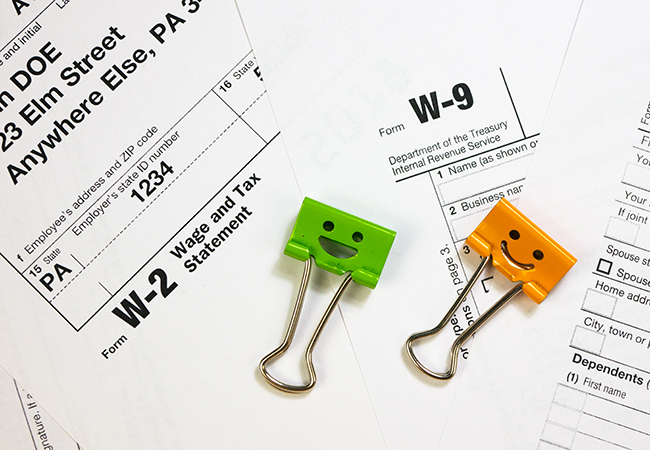
Tax season can feel overwhelming for business owners and HR professionals, especially when navigating IRS forms. A common question is the difference between W2 vs W9 forms. Using the wrong form is not just an administrative mistake—it can lead to IRS penalties, back taxes, and compliance issues that affect payroll, workers’ compensation, and unemployment insurance.
Worker misclassification is a frequent compliance issue. If a worker is treated as an independent contractor but legally qualifies as an employee, the business may owe unpaid employment taxes, penalties, and interest. Understanding when to use a W-2 versus a W-9 helps reduce this risk.
Whether you are hiring your first employee, paying freelancers, or reviewing your workforce structure, this guide explains when to use a W-2 versus a W-9, what each form does, and what responsibilities follow.
Understanding the W2 vs W9 Fundamentals
W-2 and W-9 are IRS tax forms used for different worker types and different reporting purposes.
What Is a W-2 Form?
The W-2, officially called the “Wage and Tax Statement,” is issued by an employer to an employee after the end of the tax year. It reports the employee’s annual wages and the taxes withheld from pay.
Key information included on a W-2:
- Total wages, tips, and other compensation
- Federal income tax withheld
- Social Security wages and taxes withheld
- Medicare wages and taxes withheld
- State and local tax withholding (if applicable)
- Employer and employee identification details
- Pre-tax benefits and deductions
Employers must provide W-2 forms to employees by January 31 following the tax year and file copies with the Social Security Administration. A W-2 is the standard year-end record of employee wages and payroll tax withholding.
What Is a W-9 Form?
The W-9, titled “Request for Taxpayer Identification Number and Certification,” is used to collect tax identification information from independent contractors and certain vendors before payment.
The W-9 captures:
- Legal name and business name (if different)
- Federal tax classification (sole proprietor, LLC, corporation, etc.)
- Taxpayer Identification Number (SSN or EIN)
- Business address
- Certification that the information is accurate
The W-9 is not filed with the IRS. Businesses keep it on record to prepare Form 1099-NEC for contractors paid $600 or more during the year.
W2 vs W9: The Critical Differences Explained
The key difference between W-2 and W-9 forms is worker classification: employee versus independent contractor.
Employee Classification: The Foundation of Form Selection
The IRS generally evaluates classification using behavioral control, financial control, and the type of relationship. Classification is based on how the work is actually performed—not the job title or contract label.
Employees (W-2 Workers) typically:
- Work schedules set by the employer
- Use company-provided tools and systems
- Receive ongoing supervision or training
- Cannot delegate work without approval
- Perform services central to the company’s operations
- Have an indefinite or long-term relationship with the company
Independent Contractors (W-9 Workers) typically:
- Control how and when work is performed
- Provide their own equipment and tools
- Work with multiple clients
- Operate under project-based or contract terms
- Invoice for services
- Bear the risk of profit or loss
If classification is unclear, reviewing the relationship before payroll or payments are processed can reduce the risk of reclassification. You can estimate classification-related costs and coverage considerations here: https://peopaygo.com/get-rate-exchange-blogs/u/step-1.
Tax Withholding Responsibilities
Tax withholding differs sharply between W-2 employees and W-9 contractors.
For W-2 Employees:
Employers must withhold and remit:
- Federal income tax (based on Form W-4)
- Social Security tax (6.2% up to the annual wage base)
- Medicare tax (1.45% of wages, plus additional Medicare tax where applicable)
- State and local income taxes, if required
Employers also pay the employer share of Social Security and Medicare taxes (7.65%) and typically pay unemployment insurance taxes.
For W-9 Contractors:
In most cases, businesses do not withhold taxes from contractor payments. Contractors are responsible for:
- Self-employment tax (15.3% covering both portions of Social Security and Medicare)
- Quarterly estimated tax payments
- All federal, state, and local income tax liability
Employer Responsibilities for Each Form Type
Employer responsibilities depend on whether the worker is an employee or an independent contractor.
W-2 Employer Obligations
Hiring employees typically requires the employer to manage:
Payroll Processing:
- Calculate and withhold payroll taxes each pay period
- Deposit payroll taxes on the required schedule
- File quarterly Form 941 payroll reports
- Maintain payroll records for at least four years
Year-End Reporting:
- Issue W-2 forms by January 31
- File W-2 copies and Form W-3 with the Social Security Administration
Additional Compliance:
- Maintain workers’ compensation insurance
- Pay unemployment insurance taxes
- Comply with wage and hour laws (minimum wage, overtime)
- Follow applicable federal and state employment regulations
W-9 Employer Obligations
Independent contractor arrangements usually involve fewer payroll obligations but still require recordkeeping and year-end reporting.
Before Payments Begin:
- Collect a completed W-9 before issuing payment
- Confirm the Taxpayer Identification Number when necessary
- Execute a written independent contractor agreement
Year-End Reporting:
- Issue Form 1099-NEC to contractors paid $600 or more during the year
- File 1099-NEC forms with the IRS by January 31
- Retain W-9 records for documentation
The Financial Impact: Taxes, Deductions, and Bottom Line
The W2 vs W9 decision affects labor cost, tax liability, and insurance requirements.
Cost Comparison for Employers
Employees often cost more than contractors because employers may pay:
- Employer FICA taxes (7.65%)
- Unemployment insurance
- Workers’ compensation premiums
- Benefits (if offered)
- Payroll administration costs
Contractors often charge higher rates to cover self-employment taxes and the lack of benefits, but employers typically avoid payroll tax matching and some employee-related insurance costs.
For businesses evaluating total workforce cost—including workers’ compensation exposure—reviewing projected payroll classifications and rates in advance can be helpful: https://peopaygo.com/get-rate-exchange-blogs/u/step-1.
Tax Deductions and Business Expenses
Employee wages and contractor payments are generally deductible business expenses, but they are recorded differently.
Employee Wages: Typically deducted as wages and compensation, including employer-paid payroll taxes and eligible benefits.
Contractor Payments: Typically deducted as contract labor or professional services. Proper 1099 reporting helps document the expense.
Tax Liability Considerations
Worker misclassification can trigger tax and wage liabilities, including:
- Assessment of unpaid employment taxes
- Penalties and interest
- Liability for unpaid overtime or benefits
- State-level fines and audits
In serious cases, total penalties and assessments can be significant.
Common Mistakes to Avoid During Tax Season Preparation
Mistake #1: Misclassifying Workers
A contract label does not control classification. If the business controls how work is performed, the worker may be an employee under IRS and state rules.
Mistake #2: Missing Filing Deadlines
Late W-2 or 1099 filings can trigger penalties that generally increase the longer forms remain unfiled.
Mistake #3: Incorrect Taxpayer Information
Incorrect names, addresses, or Taxpayer Identification Numbers can cause IRS notices and may require corrections or backup withholding.
Mistake #4: Collecting W-9 Forms Too Late
Collect W-9 forms before the first payment so year-end 1099 reporting is not delayed.
Best Practices for Managing Tax Forms and Worker Classification
Establish Clear Onboarding Procedures
Use separate onboarding processes for employees and contractors. Employees typically require Form W-4, Form I-9, payroll setup, and benefit enrollment. Contractors typically require a signed agreement and a completed W-9.
Maintain Written Documentation
- Signed contracts
- Defined scopes of work
- Invoices and payment records
- Evidence of independent business activity (for contractors)
Use Reliable Payroll and Accounting Systems
Payroll and accounting systems can reduce calculation errors and help track key filing deadlines.
Review Classification Annually
Worker relationships can change over time. A contractor role can shift toward an employee relationship if control and dependency increase, so periodic reviews help prevent compliance issues.
Monitor State Law Differences
State worker-classification rules can be stricter than federal guidelines. Multi-state employers should review both federal and state standards.
When to Seek Professional Guidance
Consider consulting a CPA, employment attorney, or HR advisor if you face:
- Unclear worker classifications
- Rapid workforce expansion
- Multi-state compliance questions
- IRS or state agency inquiries
- Workers’ compensation disputes involving classification
Conclusion: Making the Right W2 vs W9 Decision
The difference between W2 vs W9 forms is simple: use a W-2 for employees (wages and payroll tax withholding) and use a W-9 to collect tax information for independent contractors (to support 1099-NEC reporting).
Classification affects more than tax forms. It can change payroll taxes, insurance requirements, legal protections, and financial risk. Proactive reviews and clear documentation reduce the chance of audits, reclassification, and penalties.
If classification is uncertain, professional guidance before payments begin is often less costly than fixing misclassification later.
This article is for general informational purposes and does not constitute legal or tax advice. Always consult qualified professionals for guidance specific to your business.