Workers comp for small business is one of the most important — and most misunderstood — areas of compliance. Even employers who carry coverage often make costly mistakes that drive up premiums, trigger audits, or leave them exposed when an injury happens. A single workers compensation mistake can cost more than years of premium savings.
Workplace injuries are common across every industry. According to the U.S. Bureau of Labor Statistics, approximately 2.6 million nonfatal workplace injuries and illnesses occur each year in the private sector, and small businesses bear a significant share. Strong workers compensation management protects employees, reduces financial exposure, and supports long-term workforce stability. The first step is knowing what mistakes to avoid.
Below is a clear breakdown of the seven most common workers comp mistakes small businesses make, why they matter, and how to fix them.
Why Workers Comp Mistakes Hurt Small Businesses
Workers compensation insurance is required in nearly every state (Texas is the only state where it is optional for most private employers). It pays for medical care and lost wages when an employee gets hurt on the job. For small businesses, mistakes in coverage, classification, or claims management can lead to:
- Surprise audit bills
- Higher premium rates
- State penalties and fines
- Increased experience modification rate (EMR)
- Lawsuits and personal liability
- Coverage cancellations
- Lost contracts that require proof of coverage
Most of these problems are avoidable. The list below covers the seven most common mistakes and how to prevent them.
Mistake #1: Skipping Workers Comp Coverage
Some small business owners assume workers comp is optional, especially if they only have a few employees, hire part-time workers, or rely on subcontractors. In most states, that assumption is wrong.
Why It’s a Problem
Operating without required workers comp coverage can lead to:
- Stop-work orders
- State fines that scale with payroll
- Personal liability for medical costs and lost wages
- Civil lawsuits from injured workers
- Loss of business licenses and permits
How to Fix It
- Confirm your state’s workers comp requirements
- Get coverage as soon as you hire your first employee (sometimes earlier)
- Confirm whether sole proprietors and officers need coverage
- Remember that four monopolistic states (Ohio, North Dakota, Washington, and Wyoming) require employers to purchase coverage through a state-run fund rather than private insurers
- Verify subcontractor coverage to avoid being held responsible
- Keep current certificates of insurance on file
Mistake #2: Misclassifying Employees
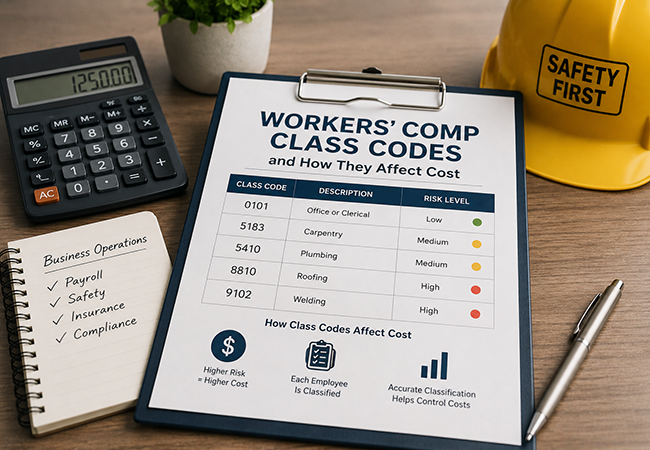
Workers comp premiums are based on job classifications. Most states use NCCI class codes (or state equivalents), with each role assigned a rate tied to the level of risk. Misclassifying employees, even unintentionally, leads to inaccurate premiums and major audit problems.
Why It’s a Problem
- Incorrect class codes inflate or deflate premiums
- Audits can trigger massive back-premium bills
- Misclassification can violate state insurance regulations
- Claims may be denied if the worker’s actual duties don’t match the policy
- Repeated mistakes can lead to fraud allegations
How to Fix It
- Review every employee’s actual job duties, not their title
- Work with your carrier or broker to assign accurate class codes
- Update classifications when responsibilities change
- Document all roles in writing
- Confirm classifications at every renewal
Mistake #3: Misclassifying Employees as Independent Contractors
Worker classification is one of the most enforced areas of employment law. Many small businesses treat workers as 1099 contractors to avoid payroll taxes and workers comp premiums. The IRS, DOL, and state agencies all watch this closely.
Why It’s a Problem
- Back premium charges during audits
- Back payroll taxes and unemployment contributions
- Penalties from federal and state agencies
- Liability for medical costs and lost wages if a contractor is injured
- Civil lawsuits from misclassified workers
How to Fix It
- Use IRS classification factors (behavioral control, financial control, type of relationship)
- Apply the stricter ABC Test if you operate in California, Massachusetts, New Jersey, Illinois, or other states that use it
- Document the working relationship in writing
- Collect Form W-9 from all contractors
- Verify each contractor’s workers comp coverage
- Use Form SS-8 when classification is unclear
Mistake #4: Underreporting Payroll
Workers comp premiums are based on actual payroll. Some small business owners try to lower premiums by underreporting wages, leaving off subcontractor payments, or excluding bonuses. This almost always backfires at audit time.
Why It’s a Problem
- Annual audits compare reported payroll to actual wages
- Underreporting triggers large back-premium charges
- Insurers may cancel the policy
- Fraud claims can lead to fines and legal action
- Misreported payroll affects future premium rates
How to Fix It
- Report all wages, including overtime and bonuses
- Include subcontractor payments when they aren’t covered separately
- Use pay-as-you-go workers comp for accurate, real-time reporting tied directly to each payroll run
- Integrate payroll with workers comp through a single platform when possible
- Review payroll-to-premium reports each quarter
Mistake #5: Failing to Build a Workplace Safety Program
Safety is one of the biggest drivers of workers comp cost. Small businesses without documented workplace safety programs face higher claims, higher premiums, and more OSHA exposure.
Why It’s a Problem
- Higher accident rates increase claims
- Claims drive up the experience modification rate (EMR)
- Higher EMRs increase premiums for years
- OSHA can issue citations with penalties of up to $16,550 per serious violation and up to $165,514 per willful or repeated violation
- Lack of safety documentation weakens claims defense
How to Fix It
- Build a written workplace safety program tailored to your industry
- Train new hires on safety before they begin work
- Hold periodic refresher training for all employees
- Document all training sessions and inspections
- Investigate every incident, including near misses
- Use OSHA’s free On-Site Consultation Program for small businesses
Mistake #6: Mishandling Claims After an Injury
How a business responds to a workplace injury affects everything from employee recovery to long-term insurance costs. Many small businesses delay reporting, fail to document the incident, or skip return-to-work planning.
Why It’s a Problem
- Late reporting increases claim costs
- Poor documentation weakens claim outcomes
- Delayed medical care worsens injuries and extends time off
- Lack of return-to-work programs increases lost wage claims
- Mishandled claims drive up the EMR for years
How to Fix It
- Build a written injury reporting and response process
- Train supervisors to respond quickly and document incidents
- Report injuries to the carrier within state-required timeframes
- Report fatalities to OSHA within 8 hours and hospitalizations, amputations, or loss of an eye within 24 hours
- Stay in contact with injured employees during recovery
- Develop structured return-to-work programs
- Coordinate with carriers and medical providers
- Review claim outcomes annually to find patterns
Mistake #7: Ignoring the Experience Modification Rate (EMR)
The EMR is a multiplier applied to workers comp premiums based on past claims. An EMR of 1.00 is average; below 1.00 reduces premiums, while above 1.00 increases them. Many small business owners don’t track their EMR until renewal, which is far too late.
Why It’s a Problem
- A higher EMR raises premiums for at least three years
- Many large clients won’t work with vendors above a certain EMR (often 1.0 or 1.25)
- Some government contracts require EMRs below a threshold
- An unchecked EMR can quietly damage long-term profitability
- Mistakes in claim coding can artificially inflate EMR
How to Fix It
- Review the EMR each year before renewal
- Audit past claims for errors or misclassification
- Strengthen workplace safety to reduce claim frequency
- Build return-to-work programs to limit claim severity
- Work with your broker to challenge inaccurate ratings
- Track EMR trends over time, not just one year
The True Cost of Workers Comp Mistakes
The financial impact of workers comp mistakes builds over time.
Common Long-Term Consequences
- Higher premiums for at least three years
- Loss of contracts that require low EMRs
- State fines and penalties
- Personal liability for owners and officers
- Carrier cancellations
- Difficulty securing future coverage
- Reputation damage in regulated industries
Avoiding these mistakes protects both the business and its employees.
If you want to evaluate how your workers compensation premiums, payroll, and HR compliance interact across your workforce, this baseline tool can serve as a starting reference: https://peopaygo.com/get-rate-exchange-blogs/u/step-1.
Best Practices for Strong Workers Comp Management
Strong management protects both employees and the financial health of the business.
- Maintain accurate, up-to-date job classifications
- Report all wages and subcontractor payments accurately
- Build and document a written workplace safety program
- Train employees on safety, reporting, and emergency procedures
- Investigate every injury, even minor ones
- Develop structured return-to-work plans
- Use pay-as-you-go workers comp when possible
- Track your EMR year over year
- Audit your workers comp policy annually
- Compare quotes from multiple carriers every one to three years (or contact the state fund directly if operating in Ohio, North Dakota, Washington, or Wyoming)
How Workers Comp Connects to Broader Compliance
Workers compensation is part of a larger compliance ecosystem.
Connected Compliance Areas
- OSHA workplace safety standards
- Payroll tax compliance
- Wage and hour rules
- Worker classification under the FLSA and IRS
- Multi-state employment registration
- Benefits administration
Strong workers comp management supports clean compliance across the business.
How PEOs Help Small Businesses With Workers Comp
Many small businesses use a Professional Employer Organization (PEO) to manage workers compensation alongside payroll, HR, and benefits.
What PEOs Typically Provide
- Pooled workers comp coverage at lower group rates
- Pay-as-you-go premium structures
- Claims management support
- Workplace safety training
- OSHA compliance guidance
- Return-to-work program design
- EMR review and reporting
- Multi-state coverage support
According to NAPEO research, more than 200,000 small and mid-size businesses use a PEO today, covering approximately 4.5 million worksite employees. PEO clients also benefit from pooled workers comp programs that often deliver lower rates than standalone policies. For small businesses with high injury exposure or limited HR capacity, a PEO can simplify the entire workers comp lifecycle.
Turning Workers Comp Compliance Into a Strategic Advantage
Strong workers comp management is more than risk control. It supports growth, retention, and reputation.
- Lower premiums improve long-term profitability
- Strong safety programs build a healthier workplace culture
- Clean claims records open access to larger contracts
- Documented compliance supports audits and lending
- Return-to-work programs reduce lost productivity
- Coordinated payroll and workers comp reduce audit surprises
If you want to see how bundling workers compensation with payroll, benefits, and HR compliance through a single integrated provider can reduce premiums and simplify claims management, this baseline tool can serve as a starting reference: https://peopaygo.com/get-rate-exchange-blogs/u/step-1.
Ready to strengthen your workers comp strategy? Review your coverage, classifications, and claims handling, then align workplace safety, payroll, and HR practices to protect your business, your employees, and your long-term growth.
This article is for informational purposes only and does not constitute legal, tax, or insurance advice. Workers compensation rules, NCCI class codes, EMR calculations, and OSHA penalties vary by state and change frequently. Employers should consult a qualified insurance broker, employment attorney, or risk management specialist for guidance specific to their business.